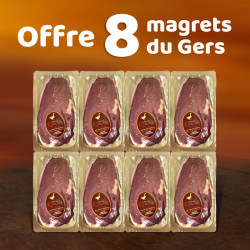


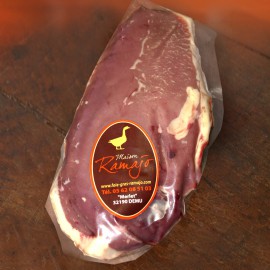
Fresh Duck Magret IGP Gers
9.00
The duck breast was first created in Auch in 1959, in the Gers region, by chef André Daguin. More than sixty years later, Maison Ramajo carries on this Gascon tradition from its family farm in Dému, 35 km from the Hôtel de France where it all began. Our duck breasts come from free-range fattened ducks, force-fed with grain corn from the Southwest, under the Canard à Foie Gras du Sud-Ouest (Gers) PGI.
Discover our fresh duck breasts ready to cook and our traditionally dried duck breasts, two signature products from a company that has been raising, force-feeding, and processing its ducks for over 55 years.
Before 1959, the fillet of the fattened duck was hardly considered a prime cut. It ended up as confit or pâté. It was in Auch, in the Gers region, that everything changed: Chef André Daguin, then 24 years old and working at the Hôtel de France, had the idea to cook this fillet like red meat—seared in a pan and served medium-rare. The modern duck breast was born.
The word comes from the Occitan “magre,” meaning lean: a reference to the meat, which contains less than 10% fat excluding the skin.
Within a few years, this daring dish had established itself in all the top restaurants of France, then the world, and became one of the most recognizable symbols of French gastronomy.
The Gers remains the birthplace of this tradition to this day. It is here, 35 km from Auch, in Dému, that Maison Ramajo raises its ducks and prepares its duck breasts, in the very same region that gave birth to this culinary masterpiece. Our shop, Le Comptoir de Tistou, located on Place de la Cathédrale in Auch, welcomes you just a few steps from the street now named after André Daguin.
Duck breast can be prepared in several ways, each suited to very different uses. At Maison Ramajo, we offer the three main categories of the Gascon tradition: fresh duck breast for cooking, dried duck breast as a fine charcuterie, and preparations stuffed with foie gras.
Dried duck breast is our specialty in fine charcuterie. Salted and then slowly air-dried in our drying rooms, it develops intense aromas, a firm texture, and a characteristic mahogany color. Thinly sliced, it is wonderful as an appetizer, on lightly buttered toast, or in thin strips in a gourmet seasonal salad.
Ramajo’s dried duck breast is crafted in strict accordance with traditional Gascon methods, with no added nitrites or preservatives.
Discover all our dried duck breasts
This is the raw cut, to be cooked at home. Our fresh IGP Gers duck breast is vacuum-sealed immediately after cutting and shipped via cold chain (Chronofresh) at 0–4°C. Each breast weighs approximately 350–400 g, making it an ideal main course serving for two people.
Discover our fresh duck breasts
Beyond fresh and cured products, Maison Ramajo prepares duck breast in dishes that showcase the richness of Gascon cuisine:
Discover our ready-to-eat dishes from the Southwest
Not all duck breasts are created equal. Here are the four criteria that distinguish an exceptional product from an industrial duck breast.
Opt for a duck breast with the IGP Canard à Foie Gras du Sud-Ouest or Label Rouge certification. These labels guarantee that the duck was born, raised, and prepared in the Southwest, fed non-GMO corn, and raised free-range. The Label Rouge adds a requirement for superior taste quality.
A good duck breast can be recognized by:
A PGI fatty duck breast generally weighs between 350 and 450 g. If it weighs less than 300 g, it is likely a standard meat duck. If it weighs over 500 g, either the cut comes from a goose (and is technically called a “goose breast”) or the bird was force-fed in an atypical manner. Ramajo duck breasts weigh an average of 360 g, in accordance with the Gers PGI specifications.
Choose integrated producers who control the entire process from raising to butchering. This is the only way to ensure full traceability and consistent quality. At Ramajo, we raise, force-feed, and butcher our ducks on the same farm in Dému: there are no middlemen between the farm and your kitchen.
How to cook the duck breast is the big question. When done right, it yields tender meat, crispy skin, and an incomparable flavor. Here are the three methods we recommend to our customers, validated by decades of practice in Gascon cuisine.
Step 1 - Preparation. Remove the duck breast from the refrigerator 30 to 60 minutes before cooking, so it returns to room temperature. Using a sharp knife, score the skin in a crisscross pattern spaced 1 to 2 cm apart, without cutting into the meat. This allows the fat to render evenly and creates a beautiful crispiness.
Step 2 - Sear the skin side. Place the duck breast skin-side down in a cold skillet, without any fat. Turn the heat to medium. The fat will melt slowly and help with cooking. Cook for 6 to 8 minutes on the skin side, until it is golden brown and crispy. During this step, regularly remove the excess melted fat with a spoon (and save it: it’s a treasure for cooking your potatoes).
Step 3 - Flip. Flip the duck breast to the flesh side. Season with salt and pepper. Then cook:
Step 4 - Rest. Remove the duck breast from the pan, wrap it in a sheet of aluminum foil, and let it rest for 5 minutes before slicing. This step is essential: it allows the juices to redistribute throughout the meat. Then slice diagonally into 1-cm-thick slices and serve immediately.
For a festive meal or when cooking several duck breasts at once, the oven is ideal. Score the skin, sear the skin side for 4 to 5 minutes in a skillet to render the fat, then bake at 180°C for 8 to 10 minutes for a pink duck breast (12 to 14 minutes for medium). Let rest for 5 minutes under aluminum foil before serving.
Score the skin, place the duck breast skin-side down on the grill over embers that aren’t too hot. Cook for 8 to 10 minutes on the skin side (watch for flames caused by dripping fat: move the duck breast if necessary), then 4 to 5 minutes on the meat side for a pink duck breast. Let rest for 5 minutes. Ideal for summer grilling.
André Daguin’s classic recipe is pink duck breast with green pepper, served with a creamy green pepper and cognac sauce, and gratin dauphinois on the side. It is still served today at the finest restaurants in Auch and the Gers region. Beyond this classic, here are the pairings that best highlight the flavor of the duck breast:
Duck breast calls for hearty starches that soak up the juices: Sarladaise potatoes (cooked in duck fat with garlic and parsley), gratin dauphinois, homemade mashed potatoes, creamy polenta, or roasted potatoes. When it comes to vegetables, the classics remain unbeatable: green beans, pan-seared porcini mushrooms, glazed turnips, or a sauté of seasonal fruits (apples, figs, grapes).
Duck breast pairs well with full-bodied, structured red wines capable of holding their own against its richness, or with a dry, lively white wine when served with fruit or a sweet-and-salty sauce.
Dried duck breast is enjoyed as a fine charcuterie: sliced very thinly, on country bread or buttered brioche toast, as an appetizer with a glass of Floc de Gascogne, or diced in a warm salad (gizzards, bacon bits, dried duck breast, walnut oil vinaigrette). It also pairs wonderfully with melon in the summer, Gascon-style prosciutto.
The price of a duck breast varies based on three criteria: the duck’s origin (standard meat or fattened duck), the label (IGP, Label Rouge, or none), and the sales channel (supermarkets, online marketplaces, or direct from the producer). Here are the price ranges observed on the French market:
Duck breast is the lean fillet cut from the breast of a fattened duck (Mulard or Barbary duck raised for foie gras production). The term “magret” comes from the Occitan word “magre” (lean) and specifically refers to the meat of a fattened duck. On a standard meat duck, it is called “duck fillet.” The modern recipe for duck breast served pink was invented in Auch, in the Gers region, in 1959 by chef André Daguin.
Score the skin in a crisscross pattern, then place the magret skin-side down in a cold skillet without any fat. Cook for 6 to 8 minutes on the skin side over medium heat, skimming off any excess fat. Flip it over, season with salt and pepper, and cook for 3 to 4 minutes for medium-rare, 5 to 6 minutes for medium, and 7 to 9 minutes for well-done. Let it rest for 5 minutes under aluminum foil before slicing.
A duck breast weighs about 350 to 400 g and is ideally shared between two people as a main course, which is about 180 to 200 g of meat per person. For 4 guests, plan on 2 duck breasts; for 8 people, 4 duck breasts or a pack of 4 to 6.
Duck breast is traditionally served pink, like red meat. Cooking it pink preserves the tenderness of the meat and fully brings out the flavors of the fatty duck. Overcooking toughens the meat and causes it to lose its aromatic nuances. This is, in fact, how André Daguin served his original duck breast at the Hôtel de France in Auch.
In the refrigerator between 0 and 4°C in its original vacuum-sealed packaging, for up to 21 days depending on the best-by date indicated. Once opened, consume within 3 to 4 days. Raw duck breast freezes very well at -18°C for up to 6 months.
The magret refers to the fillet of a fattened duck (raised for foie gras production), with denser red meat and a significant layer of fat. Duck fillet refers to the same cut, but from a standard, non-force-fed duck: the meat is lighter in color, less fatty, and has a more neutral flavor. Only duck breast is eligible for the Sud-Ouest or Gers PGI designation.
Duck breast that is cooked through (medium or well-done) poses no problem during pregnancy. However, pink or rare duck breast is not recommended due to the risk of toxoplasmosis. Dried duck breast, considered a raw meat product, is also not recommended during pregnancy for the same reason. Opt for well-cooked duck breast or sterilized ready-to-eat dishes.
Red wines from the Southwest are the most traditional pairings: Madiran, Cahors, or Saint-Émilion. For duck breast with fruit (figs, honey, orange), a Côtes du Rhône such as a Gigondas or a Châteauneuf-du-Pape works very well. For white wine, a dry Pacherenc du Vic-Bilh is an elegant option.
Yes, our entire duck production has been certified under the IGP Canard à Foie Gras du Sud-Ouest (Gers) since 2014. This means that our ducks are born, raised outdoors, force-fed with grain corn, and processed in the Gers department, in accordance with the official European specifications.
Fresh duck breasts are shipped via the cold chain through Chronofresh, at a controlled temperature between 0 and 4 °C. The package arrives within 24 to 48 hours in insulated packaging with refrigerated packs. Place it in the refrigerator immediately upon receipt. Delivery available throughout mainland France.