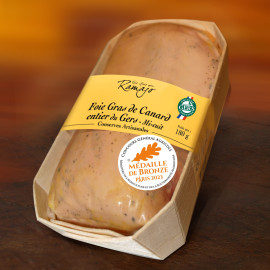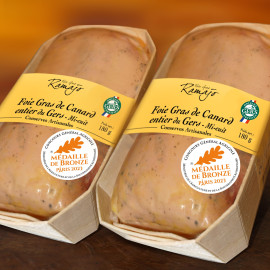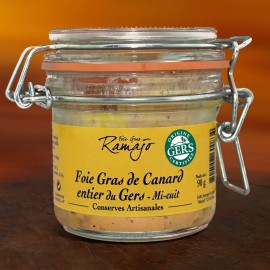


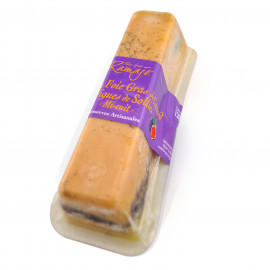
Semi-cooked Duck Foie Gras with Figs from Sollies 120 g
17.80
Maison Ramajo’s whole semi-cooked duck foie gras from the Gers region is cut to weight and seasoned with a house-made truffle-infused Armagnac mixture. This low-temperature cooking method, using a water bath maintained between 70°C and 85°C, allows the foie gras to fully express its full range of flavors. You’ll discover an incredibly melt-in-your-mouth texture, a creamy richness, and an incomparable velvety smoothness, very similar to those of fresh foie gras.
Certified IGP Gers and a multiple award winner at the Concours Général Agricole de Paris, this foie gras is a testament to the artisanal expertise the Ramajo family has cultivated for over 40 years, from raising the geese to packaging, right here in the Gers.
Enjoyed as an appetizer or with drinks on a few slices of toasted bread with a pinch of fleur de sel, semi-cured foie gras is a sure bet. The advantage of a whole foie gras: it comes from a single animal, ensuring a perfectly consistent texture and flavor.
We offer several sizes of vacuum-sealed trays to suit the number of your guests: 90 g for a solo or duo tasting, 180 g for 3 to 4 people, and 350 g for a festive gathering. Value packs are also available.
Discover our entire selection on the Gers duck foie gras page: whole canned duck foie gras, blocks, and foie gras specialties. For those who wish to plan their purchases well in advance, our whole canned duck foie gras has a shelf life of several years without compromising on quality.
Discover this splendid pink lobe, which you’ll slice delicately with a warm knife.
Place the slice on a piece of toasted country bread, add a pinch of Guérande fleur de sel, a few pink peppercorns, and a dash of freshly ground pepper. To enhance the tasting experience, pair your foie gras with fig confit or homemade chutney. Discover all our gourmet accompaniments designed to bring out the best in semi-cured foie gras.
This exceptional product is widely enjoyed during the holiday season, but there’s no reason not to treat yourself to it all year round. In the summer, a few slices on toast paired with a fresh salad make for a light and flavorful appetizer.
When it comes to wine pairings, our white wines from Gascony are the perfect choice: a sweet wine like Tariquet Premières Grives or a white Floc de Gascogne pairs remarkably well with the melt-in-your-mouth texture of the semi-cured foie gras. A Monbazillac, a Savennières, or a Pomerol are also good choices, depending on your preferences.
The main difference lies in the cooking temperature. Canned foie gras is sterilized at temperatures between 90°C and 110°C, which ensures it will keep for several years.
Semi-cured foie gras is cooked between 70°C and 85°C: this gentle cooking process better preserves the natural flavors of the foie gras and gives it a texture very similar to that of fresh foie gras. On the other hand, it has a shorter shelf life, generally 3 to 4 weeks after receipt. For food lovers, this timeframe is never a problem.
Remove the foie gras from the refrigerator 15 minutes before serving. Slice it using a long, thin blade that has been slightly warmed to ensure clean, even slices.
Arrange each slice in the center of a plate, accompanied by a few pieces of fresh fruit (figs, grapes) to add a touch of sweetness that contrasts with the richness of the foie gras. A pinch of fleur de sel and a twist of the pepper mill are all it takes to bring out the full flavors of this exceptional dish.
Maison Ramajo has been raising geese, force-feeding them, and crafting its own preserves in the Gers region for over 40 years. Each foie gras is selected, seasoned, and packaged on the family farm, with no middlemen. The IGP Gers certification guarantees the product’s origin and full traceability. The medals we’ve won at the Concours Général Agricole de Paris year after year attest to the consistent quality of our artisanal products.
If you’d like to give this semi-cured foie gras as a holiday gift or a corporate gift, our selection of gourmet gift sets featuring foie gras includes several carefully curated combinations centered around our finest specialties from the Gers region.
What is the difference between semi-cured foie gras in a tray and canned foie gras?
Semi-cooked foie gras is cooked at temperatures between 70 and 85°C: it retains flavors very similar to those of fresh foie gras and has a particularly melt-in-your-mouth texture, but has a shorter shelf life. Canned foie gras is sterilized at a higher temperature, which allows it to be stored for several years. The choice depends on your plans: whether you’ll be enjoying it soon or stocking up for the holidays.
How long can you keep semi-cured foie gras after opening it?
Once the package is opened, consume the semi-cured foie gras within 3 to 4 days, stored in the refrigerator between 2°C and 4°C. Before opening, check the best-by date on the packaging.
How do you slice semi-cured foie gras without damaging it?
Take it out of the refrigerator 15 minutes before serving. Use a long, thin blade that has been rinsed under hot water and dried. Slice in one smooth motion, without sawing. For more information on pairings and garnishes, check out our article “Foie Gras Toasts: Recipes and Tips.”
Can you freeze vacuum-sealed semi-cured foie gras in a tray?
This is not recommended. Freezing alters the texture and causes a loss of fat upon thawing. Buy the amount appropriate for your guests and enjoy it fresh.
Is Ramajo’s semi-cured foie gras IGP Gers certified?
Yes. All of our semi-cured whole duck foie gras products are IGP Gers certified, guaranteeing that the ducks were raised, force-fed, and processed in the Gers region. They have won multiple awards at the Concours Général Agricole de Paris.