

Golden, crispy skin, pink and tender flesh, juices pearling at the cut… Oven-roasted duck breast is the promise of a generous, masterful, and flavorful dish. But you need to know the right techniques!
Oven temperature, cooking time, resting the meat: every detail matters to elevate this noble cut of South-West French gastronomy.
In this guide, we share all the keys, from preparation to plating, to perfectly cook your duck breast in the oven like a chef.
Why cook duck breast in the oven?
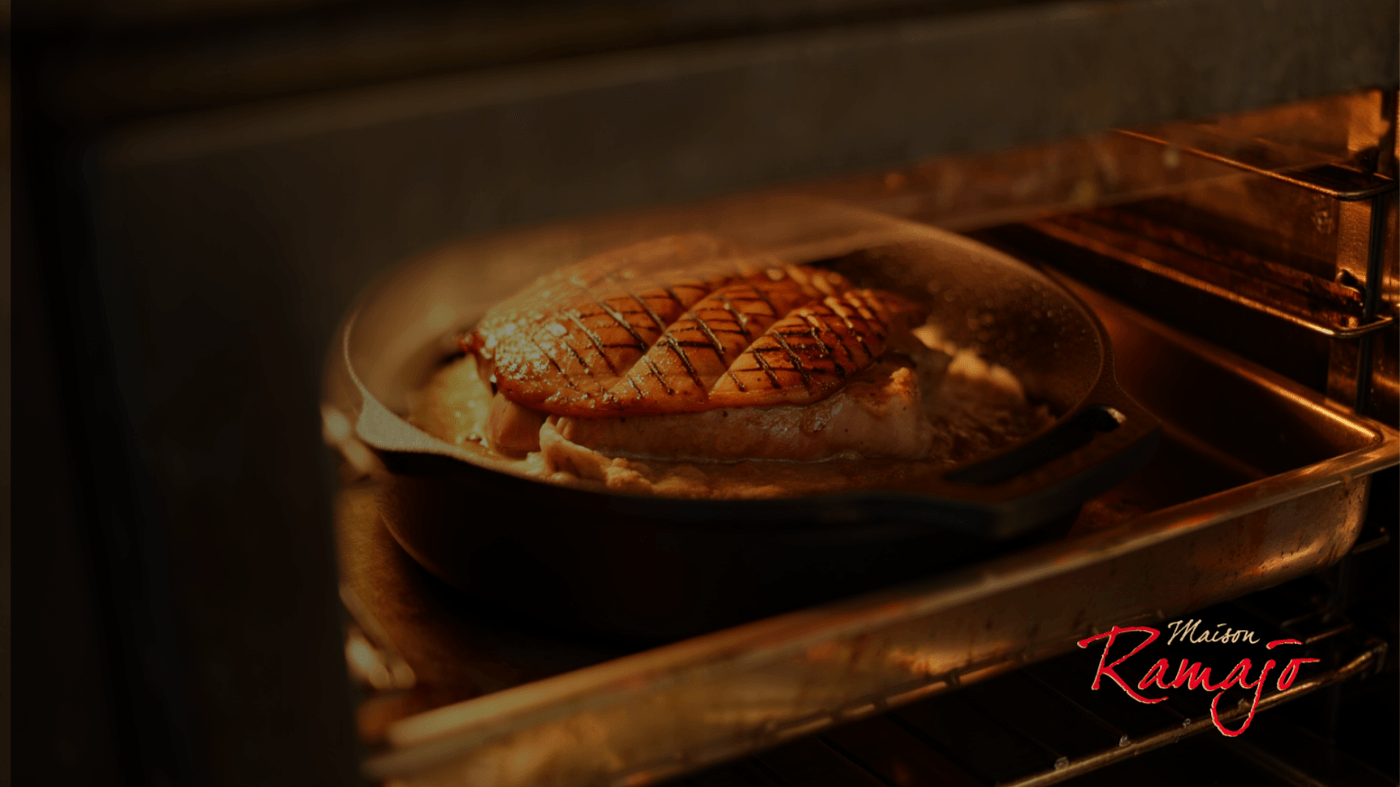
Duck breast lends itself to many cooking methods: pan-searing, griddle, barbecue, low temperature… But oven cooking remains the one that offers the best compromise between simplicity and control over the result.
Unlike the pan, where the heat must be constantly monitored, the oven distributes an enveloping and even heat. This gentle, uniform cooking preserves the tenderness of the meat while achieving perfectly crispy skin without the risk of burning it.
It is also the most practical method when entertaining guests: you can sear your duck breasts in advance, then start the oven cooking at the last moment, while you enjoy aperitifs with your guests.
Oven cooking is also less messy and produces fewer odors.
Choosing the right duck breast
Duck breast vs. duck fillet: what's the difference?
Duck breast (magret) comes exclusively from a fattened duck, meaning a duck raised for foie gras production. This is what gives it its generous thickness, its rich layer of fat, and its distinctive flavor.
Duck fillet, on the other hand, comes from a lean duck: it is thinner, less marbled, and lacks the same aromatic richness.
What to look for in a good duck breast
Choose a duck breast bearing an IGP (Protected Geographical Indication) South-West label or a Label Rouge, which guarantee quality and traceability.
At Maison Ramajo, our fresh duck breasts come from ducks raised in the Gers, in the heart of Gascony, following artisanal expertise passed down from generation to generation.
- Well-fleshed, with an even thickness
- A deep red color on the meat side, a sign of quality meat
- Firm, smooth, and intact skin, without spots or tears
- Weighing between 350 and 450 g, an ideal portion for 2 people
How many duck breasts should you plan for?
As a general rule, count 1 duck breast for 2 people. For tables of hearty eaters, plan for 3 duck breasts for 5 guests.
If you are serving a festive meal with several courses, half a duck breast per person may be enough.
Duck breast cooking recipe: the essential steps
Preparing the duck breast is a crucial step, too often overlooked. These simple steps directly determine the final result.
Take the duck breast out of the refrigerator in advance
This is a golden rule for all meats, and duck breast is no exception: take it out of the refrigerator 30 minutes to 1 hour before cooking. Meat at room temperature cooks much more evenly.
Score the skin of your duck breast
Take a sharp knife and score the skin in a crosshatch pattern, drawing parallel lines about 1.5 cm apart, then crossing in the other direction to create diamond shapes. Be careful to cut only through the fat, without reaching the meat.
This scoring serves three essential purposes:
- It promotes the rendering of fat during cooking, which results in crispy, light skin
- It prevents the duck breast from shrinking under the effect of heat
- It facilitates the even distribution of heat throughout the entire cut
Trim the duck breast
Remove excess fat from the edges of the duck breast if needed. The thin membrane that sometimes covers the meat can also be removed. However, keep the main fat layer: it protects the meat during cooking and gives it its incomparable tenderness.
Season with precision
Season the duck breast on the meat side with salt and pepper. You can add a touch of fleur de sel at the end of cooking for a delicate crunch. A few aromatics such as fresh thyme, crushed garlic, or rosemary will add a subtle hint of fragrance.
Chef's tip: Never pierce the meat with a fork during preparation or cooking. Each puncture lets the juices escape and dries out the meat.
Cooking duck breast in the oven, step by step
Cooking duck breast in the oven actually takes place in two stages: a sear in the pan, then a finish in the oven. This two-step cooking method delivers the best results.
Step 1: Sear the duck breast in a pan
This may seem surprising given the title of this article, but this preliminary step is essential. The oven alone cannot achieve crispy, golden skin. That is why we recommend pan-searing your duck breast before oven cooking.
Place the duck breast skin-side down in a hot pan, over medium heat, without adding any fat. The duck fat is more than enough.
Cook for 5 to 6 minutes, regularly draining the rendered fat into a bowl (don't throw it away — it's excellent for cooking sarladaise potatoes!).
When the skin is nicely golden and crispy, flip the duck breast to the meat side and let it sear for 1 to 2 minutes to lightly caramelize the surface.
Remove the duck breast from the pan.
Good to know: You can complete this step in advance and store the duck breast in the refrigerator. Simply put it in the oven just before serving.
Step 2: Oven cooking
Preheat your oven to 180 °C (conventional heat preferred). Place the duck breast in an oven-safe dish, skin-side up, and put it in the oven.
Cooking times by preference:
| Desired doneness | Oven time (after searing) | Internal temperature |
|---|---|---|
| Pink (recommended) | 5 to 8 minutes | 54-57 °C |
| Medium | 8 to 12 minutes | 58-63 °C |
| Well done | 12 to 15 minutes | 65-70 °C |
Important: These times are given as a guide. They vary depending on the thickness of the duck breast, the power of your oven, and whether or not the meat was brought to room temperature beforehand.
Step 3: Let your duck breast rest
This is perhaps the most important step, yet the one most often forgotten. Once out of the oven, let the duck breast rest for 5 to 10 minutes, ideally wrapped in aluminum foil.
During resting, the muscle fibers relax and the juices redistribute evenly throughout the meat. Without this pause, the juices escape when slicing and the duck breast loses tenderness and flavor. A well-rested duck breast will be noticeably more tender and juicy.
Oven cooking without prior searing: is it possible?
If you prefer a 100% oven method, it is entirely feasible. Here's how to proceed:
- Preheat the oven to 200-220 °C
- Place the scored duck breast directly in a dish, skin-side down first
- Bake for 12 to 15 minutes skin-side down
- Flip the duck breast and continue cooking for 6 to 8 minutes meat-side down
With this method, the skin will be less crispy than with a pan sear, but the cooking will be simpler and flavorful enough for an everyday meal. Allow about 20 minutes for a pink result and about 30 minutes for medium doneness.
Low-temperature oven cooking for duck breast
For those who love ultra-precise cooking, low temperature is a remarkable option. It requires more patience, but the result is stunning: exceptionally tender meat with perfectly even doneness from edge to center.
- Sear the duck breast in a pan as described above
- Preheat the oven to 80 °C (conventional heat)
- Place in the oven and cook for about 1 hour
- Monitor the internal temperature with a probe thermometer: aim for 57-60 °C for a pink duck breast
This technique is particularly well-suited when you need to cook several duck breasts at once, for a festive dinner, for example.
What to serve with oven-roasted duck breast?
Duck breast pairs with a wide variety of side dishes. Here are some classic pairings and a few more original ideas.
Classic South-West accompaniments
- Sarladaise potatoes: pan-fried in duck fat, garlic, and parsley — the perfect match
- Sautéed porcini mushrooms: when in season, it's a royal pairing with duck
- Gratin dauphinois: the creamy gentleness of the gratin balances the bold character of the meat
- Tarbais beans: the emblematic legume of Gascony, creamy and melt-in-your-mouth
Sweet and savory pairings
Duck loves sweet and savory combinations. Consider pairing your duck breast with a fig confit or a sweet-savory onion relish, two Maison Ramajo specialties that elevate the flavors of duck breast.
Sauces based on honey, citrus, balsamic vinegar, or red berries also work wonderfully. A honey-rosemary sauce, for example, adds a sweet and fragrant note that enhances the crispy skin.
How to slice duck breast
Once the resting time has elapsed, it's time to slice. And here again, technique matters.
Slice the duck breast on the bias, tilting your knife at about a 45° angle, to obtain slices 5 to 7 mm thick. This diagonal cut yields wider and more presentable slices that reveal a beautiful pink gradient at the center.
Arrange the slices in a fan shape on the plate, drizzle with a thread of sauce or the juices released during resting, and serve immediately. The elegance of a well-sliced duck breast is already mouth-watering before the first bite.
What wine to serve with duck breast?
Duck breast calls for a full-bodied red wine, but without excessive power so as not to overwhelm the finesse of the meat.
The great classics: a Madiran, a Cahors, or a Saint-Émilion pair magnificently with duck breast. South-West wines, the homeland of fattened duck, naturally offer the most harmonious pairings: a red Côtes-de-Gascogne, a Fronton, or a Buzet will be perfect table companions.
If you are preparing a duck breast with a fruit sauce (orange, cherry, raspberry), a slightly softer and fruitier red such as a Pinot Noir from Alsace or a Côtes-du-Rhône will be more suitable.
Frequently asked questions about oven-cooked duck breast
Can you prepare the duck breast in advance and cook it in the oven later?
Yes, this is actually one of the great advantages of this method. You can sear the duck breast in the pan during the day, store it in the refrigerator, then cook it in the oven 15 to 20 minutes before sitting down to eat.
Should you remove the skin before cooking?
No, absolutely not. The skin and its fat layer protect the meat during cooking, add tenderness, and allow you to achieve that famous crispiness. You can, however, trim the excess fat from the edges.
My duck breast is too small / too large: how do I adjust the cooking time?
The rule is simple: the thicker the duck breast, the longer the cooking time. Adjust in increments of 2 to 3 minutes. A cooking thermometer remains your best ally for a no-surprise result.
How to reheat an already cooked duck breast?
Wrap it in aluminum foil and place it in the oven at 120 °C for about ten minutes. Avoid the microwave, which makes the skin soft.
Can you freeze a fresh duck breast?
Yes. A fresh vacuum-sealed duck breast freezes very well for 2 to 3 months. Remember to thaw it in the refrigerator the day before cooking.
Do we say "pink" or "rare" for duck breast?
A small linguistic note that purists will appreciate: for poultry, we refer to "pink" doneness rather than "rare." The term "rare" is reserved for red meats (beef, lamb). Duck breast is therefore enjoyed pink — the ideal doneness for tender and juicy meat.